Word Count Targets for Blog Posts, Essays and Social Posts
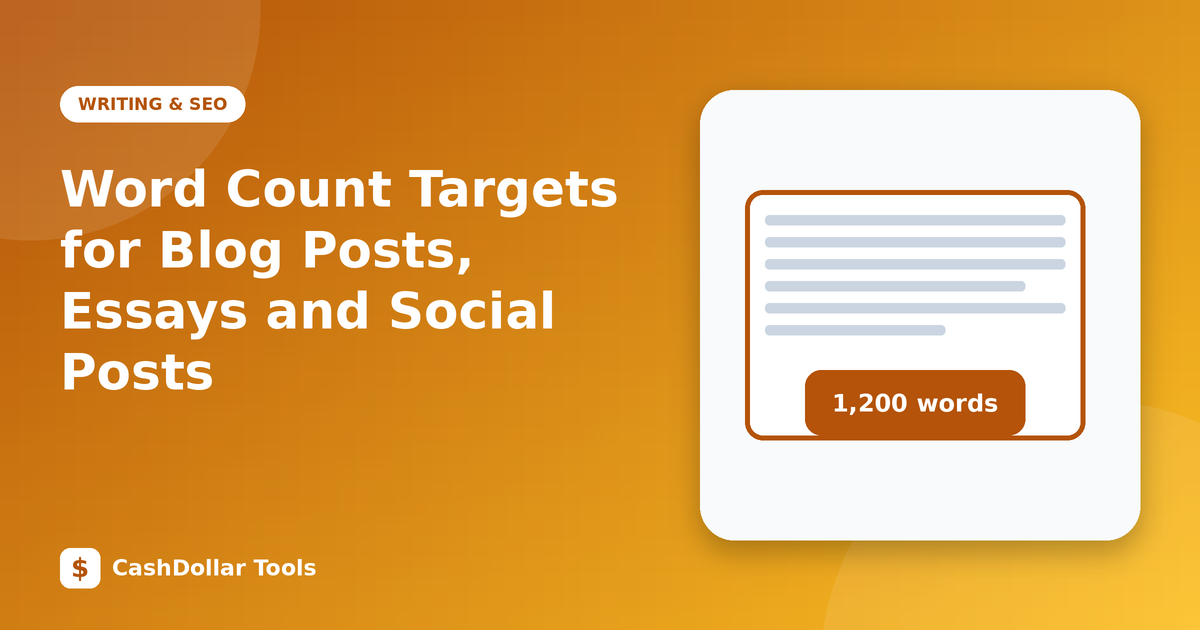
"How long should it be?" is one of the first questions every writer asks. There is no universal answer, but there are sensible ranges that help you plan.
Start with the reader's need
Length should be decided by what the reader needs to understand or do. A short answer to a simple question should be short. A complex topic deserves depth. Padding a post to reach a number makes it worse, and search engines say plainly that there is no ideal word count for ranking.
Typical ranges
- Blog post: 600 to 1,500 words suits many topics. Detailed guides and tutorials can reach 2,000 or more, if every section earns its place.
- News article: 300 to 800 words.
- Academic essay: follow the brief exactly. Many assignments allow a tolerance of about 10 percent above or below the target.
- Product description: 50 to 200 words, focusing on benefits and specifications.
- Email newsletter: 200 to 500 words with one clear call to action.
- Meta description: around 150 to 160 characters before it may be truncated in results.
- Page title: about 50 to 60 characters is a safe visible length.
- X (Twitter) post: 280 characters for standard accounts.
- LinkedIn post: the limit is 3,000 characters, though the first two or three lines are what show before "see more".
- Résumé summary: 3 to 4 lines.
Words, characters and reading time
A common estimate is that adults read around 200 to 250 words per minute silently, and speak around 130 to 150 words per minute. A 1,000-word article therefore takes about four to five minutes to read and seven to eight to say aloud. Use this for planning talks and videos.
How to hit a target without padding
- Under length? Add an example, a counterargument, a definition or a short list of steps.
- Over length? Remove repetition, shorten introductions, and cut sentences that do not add information.
- Structure first. An outline with headings makes it easier to allocate words to each part.
Check readability, too
Short sentences and plain words help readers. Aim for paragraphs of two to four sentences. Read the text aloud; awkward phrases stand out immediately.
Use a counter wisely
A word counter shows words, characters, sentences and paragraphs. Check it at the end, not constantly while drafting, so the numbers do not interrupt your flow. Note that different programs count hyphenated words and numbers differently, so a small variation is normal.
Bottom line
Write as long as the topic requires and no longer. Use word counts as a planning tool, not a goal in themselves.